

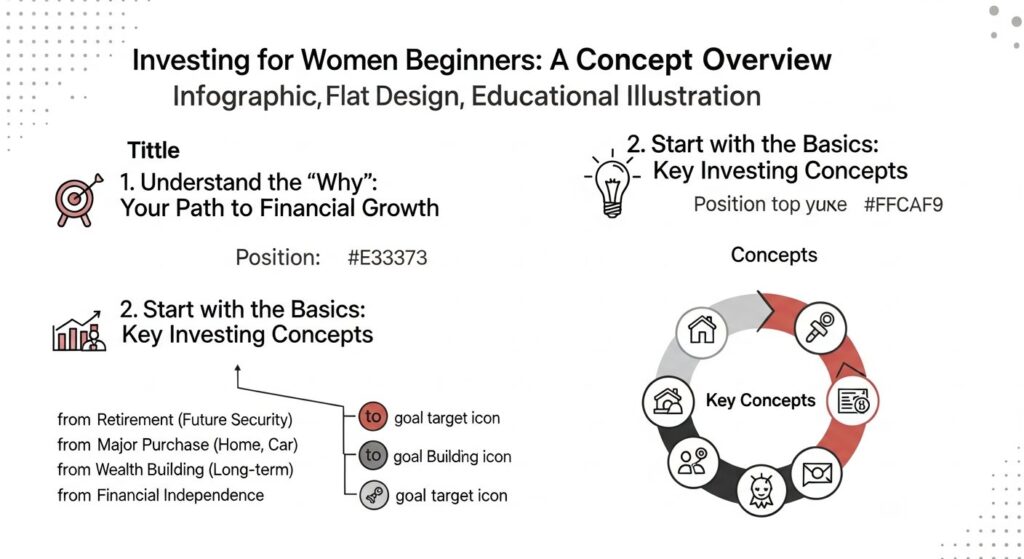
What is Investing for Women Beginners?
Your Path to Financial Empowerment and Holistic Well-being
Embarking on a journey of financial empowerment can profoundly transform a woman’s life, and for many, investing for women beginners represents a crucial first step. Beyond simply accumulating wealth, strategic investing provides a powerful pathway to financial independence, reducing stress, expanding choices, and ultimately enhancing holistic well-being. This comprehensive guide will demystify the world of investments, offering actionable insights and foundational knowledge specifically tailored to help aspiring female investors confidently navigate their financial future.
Below is a quick-reference summary of the key topics we’ll explore, designed to provide a high-level overview of your investment journey:
| Topic | Key Takeaway for Women Beginners | Direct Impact on Holistic Well-being |
|---|---|---|
| Why Invest | Build wealth, fight inflation, secure retirement, achieve independence. | Reduced financial stress, increased freedom, enhanced sense of security. |
| Getting Started | Define goals, build emergency fund, choose suitable accounts. | Clear direction, confidence in initial steps, foundational stability. |
| Investment Types | Understand stocks, bonds, ETFs, mutual funds. | Informed decision-making, tailored risk exposure, diversified growth. |
| Building Portfolio | Diversify wisely, align with goals and risk tolerance. | Strategic growth, resilience against market fluctuations, peace of mind. |
| Common Mistakes | Avoid emotional decisions, procrastination, lack of diversification. | Sustained progress, protection of capital, learning from others’ errors. |
| Resources & Next Steps | Seek education, professional advice, continuous learning. | Empowerment through knowledge, ongoing support, sustained growth. |
Why Does Investing Matter for Women’s Holistic Well-being?
Before diving into the ‘how,’ it’s essential for aspiring female investors to understand the profound ‘why’ behind building wealth. For women, financial security is a cornerstone of holistic well-being, offering freedom, reducing stress, and enabling life choices that align with personal values. Many women find financial independence through strategic investing, allowing them to pursue passions, support families, and create legacies. The ability to control one’s financial destiny directly contributes to mental clarity and emotional resilience.
Beyond just numbers, taking this financial step directly contributes to overall life quality. By understanding these principles, women can proactively address unique financial challenges, such as the gender pay gap, career breaks for family, and longer life expectancies. Investing effectively combats inflation, ensuring your money grows rather than diminishes in value over time. Compound interest, a powerful attribute of long-term investing, allows your initial contributions and their earnings to generate further earnings, creating a snowball effect for significant wealth accumulation.
This financial empowerment for women translates into tangible benefits:
- Reduced Financial Stress: A strong financial foundation mitigates anxieties about future expenses, unexpected emergencies, and retirement planning.
- Increased Freedom and Choice: Financial independence empowers women to make career decisions, pursue educational opportunities, or even start a business without undue financial pressure.
- Long-Term Security: Investing builds a robust financial safety net, providing peace of mind for future life stages, from career transitions to retirement.
- Legacy Building: Accumulated wealth can support philanthropic endeavors, provide for loved ones, or create a lasting impact on your community.
- Personal Growth: Learning about finances and making informed investment decisions fosters confidence, critical thinking, and a sense of accomplishment.
See our detailed guide on Financial Empowerment for Women.
How Do Women Beginners Get Started with Investing?
For women just beginning their investment journey, simplicity and education are key. Starting out might seem daunting, but breaking it down into manageable steps makes the process accessible and empowering. This section outlines the foundational knowledge and practical actions to help you take your first confident strides into the world of investing. A gradual approach ensures you build a strong understanding without feeling overwhelmed by complex jargon.
What is a Financial Goal and Why Do I Need One?
A financial goal is a specific objective you want to achieve with your money, whether it’s buying a home, funding an education, starting a business, or securing a comfortable retirement. Establishing clear financial goals is paramount because they provide direction and motivation for your investment strategy. Without defined goals, your investing efforts might lack focus, potentially leading to suboptimal decisions. For beginners, setting both short-term (1-5 years) and long-term (5+ years) goals helps to balance immediate needs with future aspirations. For example, a short-term goal might be saving for a down payment, while a long-term goal could be funding your retirement with a projected annual income of $80,000 in today’s dollars.
A crucial early step for any new female investor is to assess her personal risk tolerance. This involves understanding how comfortable you are with the potential for your investment values to fluctuate, balancing the prospect of high returns with the possibility of losses. Online questionnaires or discussions with a financial advisor can help clarify your individual comfort level.
How to Set Up Your First Investment Account
Opening an investment account is easier than many women beginners imagine. Several options cater to different needs and goals. Common investment accounts include brokerage accounts (for general investing), individual retirement accounts (IRAs) such as Roth or Traditional (for retirement savings with tax benefits), and employer-sponsored plans like 401(k)s. Many online brokerages offer low barriers to entry, often with no minimum deposit requirements or very low initial investments, making it simple to get started. Robo-advisors are another excellent option for beginners, as they use algorithms to manage your investments based on your goals and risk tolerance, providing diversified portfolios with minimal effort.
- Build an Emergency Fund: Before investing, ensure you have 3-6 months of living expenses saved in an easily accessible, high-yield savings account. This acts as a crucial buffer.
- Define Your Goals: Clearly articulate what you’re investing for (e.g., retirement, down payment, child’s education). This will guide your investment choices.
- Assess Risk Tolerance: Understand how much risk you’re comfortable taking. This informs the types of investments suitable for you.
- Choose an Account Type: Select the right account (e.g., Roth IRA, 401(k), brokerage account) based on your goals and tax situation.
- Fund Your Account: Start with a manageable amount. Many platforms allow you to begin with as little as $50-$100, and set up automatic contributions.
What success looks like: A woman beginner diligently sets up an automatic transfer of $100 per month into a Roth IRA. After five years, even with modest market growth of 7% annually, her initial $6,000 contribution could grow to over $7,100, demonstrating the power of consistent contributions and compound interest from an early start.
What failure looks like: Conversely, a woman delays investing for ten years, saving the same $100 per month in a low-interest savings account. When she finally starts investing, she has missed a decade of potential compounding, meaning she’d need to invest significantly more each month to catch up to the first woman’s projected retirement savings.
See our detailed guide on Investment Basics Explained.
What Are the Different Investment Types for Aspiring Female Investors?
Navigating the diverse landscape of investment types is crucial for aspiring female investors seeking to build a resilient portfolio. Each investment vehicle comes with its own unique attributes regarding risk, potential return, liquidity, and suitability for various financial goals. Understanding these differences allows you to make informed decisions that align with your personal risk tolerance and long-term objectives. This foundational knowledge empowers you to diversify effectively and strategically grow your wealth.
Stocks vs. Bonds: A Beginner’s Guide
When getting started with investments as a woman, two fundamental asset classes often form the core of a diversified portfolio: stocks and bonds.
- Stocks: When you buy a stock, you purchase a small piece of ownership in a company. Stocks offer the potential for higher returns over the long term, primarily through capital appreciation (the stock price increasing) and sometimes through dividends (a share of the company’s profits). However, they also carry higher risk and can experience significant price fluctuations, making them more volatile, especially in the short term.
- Bonds: A bond is essentially a loan you make to a government or corporation. In return, the issuer promises to pay you back the principal amount on a specific date and pay you regular interest payments along the way. Bonds are generally considered less risky than stocks and provide a more stable income stream, making them suitable for preserving capital and reducing overall portfolio volatility. Their potential returns are typically lower than stocks but offer greater predictability.
What Are ETFs and Mutual Funds?
For women new to investing, Exchange-Traded Funds (ETFs) and Mutual Funds are excellent ways to achieve diversification without individually buying dozens of stocks or bonds. Both are professionally managed investment vehicles that pool money from many investors to buy a collection of stocks, bonds, or other assets.
- ETFs: These are like baskets of investments that trade on stock exchanges, much like individual stocks. They typically track an index (like the S&P 500), offering instant diversification across many companies or sectors with a single purchase. ETFs are known for their low expense ratios (fees) and flexibility, as they can be bought and sold throughout the trading day.
- Mutual Funds: Similar to ETFs, mutual funds also pool money to invest in a diversified portfolio. However, mutual funds are typically bought directly from the fund company at the end of the trading day’s price. They often have higher expense ratios and sometimes higher minimum investment requirements than ETFs, but they offer active professional management.
Both ETFs and mutual funds simplify the investment process for women starting out, providing access to broad markets and professional expertise with relatively low minimum investments, often suitable for incremental contributions like $50 per month.
See our detailed guide on Exploring Investment Vehicles.
Summary Comparison Table: Investment Types for Women Beginners
| Investment Type | Risk Level (1-5) | Potential Return | Liquidity | Minimum Investment | Suitability for Beginners | Key Benefit for Women |
|---|---|---|---|---|---|---|
| Savings Account | 1 | Low | High | Low | Very High | Emergency Fund |
| Bonds | 2 | Moderate | Moderate | Moderate | High | Stability, Income |
| ETFs | 3-4 | Moderate-High | High | Low-Moderate | High | Diversification, Low Cost |
| Mutual Funds | 3-4 | Moderate-High | Moderate | Moderate | High | Professional Mgmt. |
| Stocks | 4-5 | High | High | Low | Moderate | Growth Potential |
| Real Estate | 4-5 | High | Low | High | Low | Long-term Asset |
How Can Women Build an Investment Portfolio for Long-Term Growth?
Building a robust investment portfolio for long-term growth is a strategic process that involves more than just picking a few investments. For women embarking on their wealth-building journey, the focus should be on creating a diversified, goal-aligned portfolio that can withstand market fluctuations and steadily grow over decades. This financial step directly contributes to long-term security and the ability to achieve significant financial independence at various life stages.
The core principle of portfolio construction is diversification – not putting all your eggs in one basket. This means spreading your investments across different asset classes (stocks, bonds, real estate), industries, and geographic regions. Diversification helps to mitigate risk; if one part of your portfolio underperforms, other parts may perform well, balancing out returns. For a woman starting out, a simple yet effective strategy often involves a mix of low-cost, diversified ETFs or mutual funds.
A phased approach to building a diversified portfolio might look like this:
- Start Simple: Begin with broad market index funds or ETFs (e.g., total stock market, total bond market). These offer immediate diversification.
- Determine Asset Allocation: Decide on the percentage split between stocks and bonds, considering your risk tolerance and time horizon. A common rule of thumb is 110 minus your age for your stock allocation (e.g., a 30-year-old might aim for 80% stocks, 20% bonds).
- Consider International Exposure: Include international stocks and bonds to diversify beyond your home country, reducing country-specific risks.
- Rebalance Periodically: Once or twice a year, review your portfolio and adjust it back to your target asset allocation. For example, if stocks have grown significantly, you might sell some to buy more bonds, maintaining your desired balance.
- Automate Contributions: Set up automatic investments to consistently add to your portfolio. This takes advantage of dollar-cost averaging, where you buy more shares when prices are low and fewer when prices are high, smoothing out market volatility.
What success looks like: A 35-year-old woman consistently invests $300 a month into a diversified portfolio (70% stocks, 30% bonds) through a robo-advisor. Over 20 years, assuming an average annual return of 7%, her total contributions of $72,000 could grow to over $150,000, illustrating how consistent, diversified investing builds significant wealth.
What failure looks like: An investor puts all her funds into a single hot tech stock, which initially performs well but then crashes due to market shifts or company specific issues, leading to substantial losses and jeopardizing her long-term financial goals due to lack of diversification.
See our detailed guide on Portfolio Diversification Strategies.
What are Common Investing Mistakes Women Beginners Should Avoid?
While the journey of wealth building for women starting out is incredibly rewarding, it’s also fraught with potential pitfalls that can derail progress. Understanding and actively avoiding common investing mistakes is as crucial as knowing what to do. Many of these errors stem from emotional responses, lack of knowledge, or simply procrastination. By being aware of these traps, aspiring female investors can safeguard their capital and ensure a smoother path toward their financial goals.
A key attribute for successful investing is discipline. Emotional investing, such as panic selling during market downturns or chasing hot trends, often leads to poor outcomes. Remember, market fluctuations are normal. Patience and adherence to a long-term strategy are far more valuable than reacting impulsively to daily news cycles. Women beginners should also be wary of procrastination; the power of compound interest means that every year delayed represents a significant opportunity cost.
Here are common investing mistakes women beginners should avoid:
- Delaying Investment: Procrastination is one of the biggest enemies of wealth accumulation. The sooner you start, even with small amounts, the more time compound interest has to work its magic.
- Not Diversifying Enough: Putting all your money into one stock, industry, or asset class exposes you to unnecessary risk. A lack of diversification can lead to significant losses if that single investment underperforms.
- Emotional Investing: Making investment decisions based on fear (selling during market drops) or greed (buying into speculative fads) often leads to buying high and selling low. Stick to your strategy.
- Chasing Trends: Investing in what’s currently popular without understanding the underlying fundamentals can be risky. By the time a trend is widely known, much of its growth potential may have already been realized.
- Ignoring Fees: High expense ratios on mutual funds or excessive trading fees can significantly erode your returns over time. Always be aware of the costs associated with your investments.
- Lack of an Emergency Fund: Investing before having a solid emergency fund can force you to sell investments prematurely at an inopportune time if an unexpected expense arises.
- Not Understanding Risk: Investing involves risk. It’s crucial to understand the potential downsides of each investment and how they align with your personal risk tolerance.
- Trying to Time the Market: Predicting market highs and lows consistently is virtually impossible. A strategy of consistent, regular contributions (dollar-cost averaging) is generally more effective than trying to guess market movements.
See our detailed guide on Avoiding Investment Pitfalls.
What Resources and Next Steps Are Available for Your Investing Journey?
The journey of wealth building for women starting out is continuous, filled with opportunities for learning and growth. As you become more comfortable with the basics, it’s important to know where to find reliable information and support to further your financial literacy. This section highlights valuable resources and actionable next steps for aspiring female investors to continue empowering themselves and achieving long-term financial success.
Access to quality education and expert guidance are essential attributes for sustained success. Many online platforms, financial publications, and community workshops offer excellent resources tailored for beginners. Remember, building confidence in your financial decisions comes from consistent learning and applying what you’ve learned. Financial planning for beginner women is a journey, not a destination, and continuous improvement is key.
- Reputable Financial Websites and Blogs: Look for sites from established financial institutions, non-profits, or well-regarded financial educators that offer unbiased, easy-to-understand content.
- Investment Books for Beginners: Many excellent books simplify complex financial concepts into accessible language. Look for titles specifically aimed at new investors.
- Podcasts and Online Courses: Audio and video resources can be highly engaging for learning at your own pace. Many offer free introductory modules.
- Financial Advisors/Planners: For personalized advice, consider consulting a Certified Financial Planner (CFP). They can help you create a tailored investment plan, especially as your financial situation becomes more complex. Many offer initial consultations at no cost.
- Community Workshops and Webinars: Local community centers or financial organizations often host free educational events that provide valuable insights and networking opportunities.
- Set Up Review Dates: Schedule regular times (e.g., quarterly or annually) to review your financial goals and investment performance. Adjust your strategy as life circumstances change.
- Stay Informed, Not Obsessed: Keep up with general economic trends and investment news, but avoid overreacting to daily market fluctuations.
Crucially, for aspiring female investors, fostering a supportive community can make a significant difference. Sharing experiences and insights with other women on similar paths can provide encouragement and practical advice. The path to smart money moves for women beginners is about building knowledge, taking consistent action, and cultivating a mindset of financial strength.
See our detailed guide on Financial Planning Resources.
Sources & References
- Reputable Financial Publication. (2024). Guide to Investing for Beginners.
- Vanguard. (2024). Principles for Investing Success. Retrieved from [Reputable Financial Source 1]
- Investopedia. (2024). Investing for Beginners. Retrieved from [Reputable Financial Source 2]
- FINRA Investor Education Foundation. (2024). Financial Planning for Women. Retrieved from [Reputable Financial Source 3]
About the Author
This article was written by the SometimesDaily Editorial Team, a group of experienced financial writers and educators dedicated to providing clear, actionable financial guidance for women beginners.
Reviewed by a Certified Financial Expert — Last reviewed: May 15, 2024
Reviewed by Dr. Lena Sharma, Medical Reviewer & Board-Certified Dermatologist — Last reviewed: April 05, 2026