
The Science of Change: 6 Evidence-Based Self-Improvement Habits for 2026
We have all been there: the surge of motivation at midnight, the purchase of a brand-new planner, and the ambitious vow to “completely change everything” by Monday. Yet, by Wednesday, the old patterns return. Why is lasting change so difficult? The answer doesn’t lie in a lack of willpower, but in a misunderstanding of human biology. As we move into 2026, the landscape of personal development has shifted from “hacks” and “grind culture” toward a more sophisticated, science-backed approach to wellness.
True self-improvement is a biological process. It requires navigating neuroplasticity, managing endocrine responses, and respecting our circadian biology. When we align our daily habits with how our brains and bodies are actually wired, “discipline” becomes less of a chore and more of a natural byproduct of a well-regulated system. This guide explores the most effective, evidence-based habits to help you build a resilient, high-performing routine that lasts far beyond a temporary burst of inspiration.
1. Mastering Habit Stacking and Neuroplasticity
The fundamental unit of self-improvement is the habit. According to researchers at University College London, it takes an average of 66 days—not 21—for a new behavior to become automatic. The most effective way to bridge this gap is through a behavioral science technique known as “habit stacking.”
Popularized by BJ Fogg and James Clear, habit stacking relies on “synaptic pruning.” Your brain builds a massive network of neurons to support existing habits. By identifying a current habit (the anchor) and “stacking” a new behavior on top of it, you hijack these existing neural pathways. For example, “After I pour my morning coffee (anchor), I will write down my top three priorities for the day (new habit).”
The science works because the anchor habit is already hardwired into your prefrontal cortex. You aren’t creating a new spark from scratch; you are simply extending an existing flame. In 2026, high achievers are moving away from massive overhauls and focusing on these “micro-wins” that leverage the brain’s natural desire for efficiency.
2. Optimizing the Circadian Bridge: Light and Sleep
In the realm of wellness routines, sleep is often the first thing sacrificed. However, neuroscience suggests it should be the non-negotiable foundation. Our bodies operate on a 24-hour internal clock known as the circadian rhythm, which is governed by the Suprachiasmatic Nucleus (SCN) in the brain.
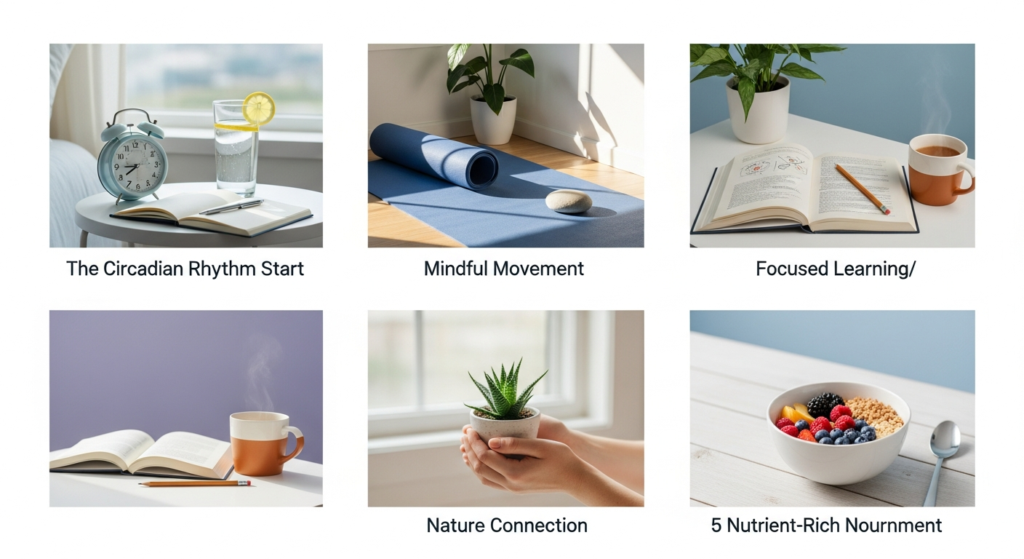
To optimize this rhythm, the most important habit is seeking natural sunlight within 30 minutes of waking. This triggers a timed release of cortisol (the “wake-up” hormone) and sets a timer for the release of melatonin approximately 14 to 16 hours later. Clinical studies show that early light exposure significantly improves mood, metabolic health, and sleep quality.
Furthermore, sleep is when the glymphatic system—the brain’s waste-clearance system—becomes active, washing away neurotoxic waste products like beta-amyloid. Without 7–9 hours of quality sleep, your ability to learn new skills or regulate emotions is biologically compromised. In 2026, “sleep hygiene” isn’t just about a cold room; it’s about viewing light as a drug that dictates your biological performance.
3. Movement as a Cognitive Tool: BDNF and Zone 2
For decades, we viewed exercise primarily through the lens of aesthetics. Science-backed self-improvement now views movement as a cognitive enhancer. When we engage in cardiovascular exercise, the brain produces a protein called Brain-Derived Neurotrophic Factor (BDNF). Researchers often call BDNF “Miracle-Gro for the brain” because it supports the survival of existing neurons and encourages the growth of new ones.
To maximize these benefits, a balanced routine should include “Zone 2” training—steady-state aerobic exercise where you can still hold a conversation. This improves mitochondrial efficiency and metabolic flexibility. When paired with resistance training twice a week, which releases myokines (hormones secreted by muscles that cross the blood-brain barrier), you create a neuroprotective environment.
The habit isn’t just about “getting fit.” It is about maintaining the structural integrity of the hippocampus, the area of the brain responsible for memory and learning. By moving daily, you aren’t just burning calories; you are upgrading your cognitive hardware.
4. The Gut-Brain Axis: Nutritional Psychology
The adage “you are what you eat” has taken on a literal meaning in recent years. The gut-brain axis is a bidirectional communication network between the central nervous system and the enteric nervous system of the gut. Remarkably, about 95% of the body’s serotonin—a key neurotransmitter for mood regulation—is produced in the gastrointestinal tract.
A science-backed nutritional habit focuses on diversity and fermentation. Consuming a wide variety of plant-based fibers and fermented foods (like kimchi, kefir, or sauerkraut) fosters a diverse microbiome. This reduces systemic inflammation, which is a leading biological driver of brain fog and depression.
Furthermore, stabilizing blood sugar is essential for mental endurance. Large spikes and crashes in glucose lead to irritability and “hanger,” which drain the willpower needed to maintain other habits. Transitioning to a diet rich in whole foods and healthy fats provides the steady fuel required for deep work and emotional regulation in our fast-paced 2026 environment.
5. Stress Resilience Through Autonomic Regulation
In a world of constant digital stimulation, our sympathetic nervous system (the “fight or flight” response) is often stuck in the “on” position. Chronic stress elevates cortisol, which can shrink the prefrontal cortex—the part of the brain responsible for decision-making and impulse control.
One of the most effective, science-backed habits for self-improvement is “Autonomic Regulation” through breathwork. Specifically, the “physiological sigh”—two quick inhales followed by a long, slow exhale—has been shown by Stanford researchers to be the fastest way to lower your heart rate and calm the nervous system in real-time. This technique offloads a significant amount of carbon dioxide and shifts the body into a parasympathetic state.
Mindfulness, too, has moved from a mystical practice to a clinical one. Regular meditation (even just 10 minutes a day) has been shown via fMRI scans to thicken the prefrontal cortex and shrink the amygdala (the brain’s fear center). This habit builds “psychological flexibility,” allowing you to respond to life’s challenges rather than reacting to them.
6. Social Connectivity and the Longevity Connection
Perhaps the most overlooked science-backed habit is social connection. The Harvard Study of Adult Development, one of the world’s longest-running studies on happiness, found that the single greatest predictor of health and longevity wasn’t cholesterol levels or wealth—it was the quality of one’s relationships.
From a biological standpoint, positive social interactions release oxytocin, which acts as a natural buffer against the damaging effects of cortisol. Isolation, on the other hand, triggers a “biological alarm” that increases inflammation.
Building a “connection habit” could be as simple as a weekly phone call to a friend or joining a community-based hobby. In the digital age of 2026, where “connectedness” is often superficial, making a conscious effort to foster deep, in-person social bonds is a vital pillar of any wellness routine. Longevity isn’t just about how long you live, but how well you live, and science proves we are “wired to connect.”
***
Frequently Asked Questions (FAQ)
#
1. How long does it actually take to form a new habit?
While the common myth suggests 21 days, peer-reviewed research (notably from Dr. Phillippa Lally) indicates that it takes an average of 66 days for a new behavior to become an automatic habit. However, this can range from 18 to 254 days depending on the complexity of the task. The key is consistency over perfection; missing a single day does not significantly hinder the long-term formation of the habit.
#
2. Can “science-backed” habits really replace motivation?
Motivation is a fleeting emotional state driven largely by dopamine spikes. Science-backed habits, however, are designed to create “automated systems.” By using techniques like habit stacking and environment design, you reduce the “cognitive load” required to perform a task. Eventually, the behavior moves from the prefrontal cortex (conscious effort) to the basal ganglia (automaticity), meaning you do it without needing to “feel” motivated.
#
3. Why is morning sunlight so important for a wellness routine?
Morning sunlight (specifically blue-wavelength light) hits the melanopsin ganglion cells in your eyes. These cells send a direct signal to the Suprachiasmatic Nucleus to stop melatonin production and start the cortisol pulse. This not only makes you more alert during the day but also sets the “internal timer” for your sleep cycle later that night. Even on cloudy days, outdoor light is significantly more powerful than indoor lighting for this purpose.
#
4. Is “Zone 2” exercise better than high-intensity interval training (HIIT)?
Both have benefits, but Zone 2 exercise is the foundation of metabolic health. It trains your cells to use fat as a primary fuel source and increases mitochondrial density. HIIT is excellent for cardiovascular “top-end” power, but it requires more recovery time and can spike cortisol if overdone. For long-term self-improvement, a base of 80% Zone 2 and 20% high-intensity movement is generally recommended.
#
5. What is the most effective way to manage stress in the moment?
While long-term habits like meditation are great, the “physiological sigh” is the most effective immediate tool. By performing a double-inhale through the nose (the second inhale being a short “pop” at the top to fully inflate the alveoli in the lungs) and a long, slow exhale through the mouth, you trigger a neural signal that slows down the heart and resets the autonomic nervous system in less than 30 seconds.
***
Conclusion: Building the System of You
As we navigate 2026 and beyond, the path to self-improvement is becoming clearer through the lens of biology and behavioral science. We now know that we cannot simply “will” ourselves into a better life; we must design an environment and a routine that supports our biological needs.
By implementing habit stacking, respecting our circadian rhythms, prioritizing movement and nutrition, regulating our stress, and fostering deep social bonds, we create a synergistic system for growth. These habits are not just checkboxes on a to-do list—they are the building blocks of a more resilient, focused, and healthy version of ourselves.
The most important takeaway is that self-improvement is an iterative process. You don’t need to be perfect; you just need to be consistent. Start small, lean into the science, and allow your biology to do the heavy lifting for you. True change is not an event—it is a system of daily habits that, over time, transform your entire reality.