
Designing for Success: Creating a Productive Home Environment for 2026
The concept of “home” has undergone a radical transformation. No longer just a place to sleep and eat, the modern residence has become a multi-functional hub where careers are built, health is forged, and personal growth is nurtured. However, as the boundaries between professional and private life continue to blur, many find themselves struggling with burnout, distraction, and stagnant habits. The problem often isn’t a lack of willpower, but a lack of environmental design.
In 2026, creating a productive home environment is about more than just buying a high-end ergonomic chair; it is about neuro-architecture—the practice of designing spaces that influence our cognitive function and emotional well-being. By intentionally curating your surroundings, you can reduce the friction required to start a new habit and increase the “flow” state required for deep work. This guide explores the essential pillars of home optimization, ensuring your living space serves as a launchpad for your most ambitious wellness and productivity goals.
1. The Psychology of Zoning: Creating Spatial Anchors
The human brain is an expert at association. If you answer emails while lying in bed, your brain begins to associate the bedroom with stress and cognitive activity, making it harder to fall asleep. Conversely, if you browse social media at your desk, your brain associates your workspace with entertainment, making it harder to focus. To build a productive home environment, you must implement “spatial anchors” through strict zoning.
Zoning doesn’t require a mansion; it requires discipline. In smaller apartments, this can be achieved through visual cues. For example, use a specific lamp that only stays on during deep work hours. When the lamp is on, your brain enters “work mode.” When it’s off, you are “off the clock.”
Ideally, you should have three distinct zones:
* **The Deep Work Zone:** A clutter-free area with minimal distractions, dedicated solely to your most important tasks.
* **The Wellness Zone:** A corner for yoga, meditation, or reading, free from digital devices.
* **The Recovery Zone:** The bedroom and living areas, where work-related items are strictly prohibited.
By physically separating these activities, you reduce the mental load of switching tasks. You no longer have to “decide” to be productive; the environment dictates the behavior for you.
2. Optimizing the Sensory Landscape: Light, Air, and Sound
Productivity is often a physiological response to external stimuli. If your home environment is too dark, too noisy, or lacks fresh air, your cognitive battery will drain faster than it can recharge.
**Lighting and Circadian Rhythms:**
In 2026, we understand more than ever how light affects the hormone cortisol and sleep-inducing melatonin. To maximize productivity, align your indoor lighting with the sun. Utilize cool, blue-toned light in the morning to stimulate alertness and focus. As the afternoon progresses, shift toward warmer, amber tones to signal to your nervous system that it is time to wind down. If possible, position your desk near a window; natural light has been proven to increase productivity by up to 15%.
**Air Quality and Cognitive Function:**
High levels of CO2 in poorly ventilated rooms can lead to “brain fog” and lethargy. To combat this, ensure regular airflow or invest in a high-quality HEPA air purifier. Maintaining a temperature between 68°F and 72°F (20°C–22°C) is generally considered the “sweet spot” for mental performance.
**Acoustics and Focus:**
Sound is one of the most significant disruptors of habit building. While some thrive in total silence, others need “brown noise” or lo-fi beats to mask background household sounds. Consider the “audio-zoning” of your home—using noise-canceling headphones for deep work and perhaps a gentle water feature in your wellness zone to create a sense of tranquility.
3. Digital Hygiene and “Focus Islands”
Our homes are filled with “digital friction.” In an era of constant connectivity, the most productive home environments are those that treat technology as a tool rather than a constant companion. To build better habits, you must create “Focus Islands”—physical areas where digital distractions are physically impossible to reach.
One of the most effective strategies for 2026 is the “Charging Station” rule. Instead of charging your phone on your nightstand or at your desk, create a central charging hub in a neutral area, like a hallway or kitchen. This forces you to be intentional about when you pick up your device.
Furthermore, consider the “Out of Sight, Out of Mind” principle. If your goal is to build a habit of reading more, place a book on your pillow every morning. If your goal is to work without distraction, place your phone in a timed lockbox or another room. By adding a physical barrier between yourself and your distractions, you conserve the willpower you would otherwise spend resisting the urge to check notifications.
4. Biophilic Design: The Productivity Power of Nature
Biophilic design—the integration of natural elements into our built environment—is not just an interior design trend; it is a fundamental requirement for psychological wellness. Humans have an innate connection to nature, and stripping that away in a clinical, “modern” home office can lead to increased stress and decreased creativity.
Integrating nature into your home environment can be done through several layers:
* **Living Greenery:** Plants like Snake Plants, Pothos, or Fiddle Leaf Figs do more than just look good. They improve air quality and provide a visual “micro-break” for your eyes, reducing digital eye strain.
* **Natural Materials:** Use wood, stone, or linen in your workspace. These textures are more grounding and soothing to the nervous system than plastic and metal.
* **Views and Imagery:** If you don’t have a view of a garden or park, use high-quality art featuring landscapes or nature-inspired color palettes (greens, blues, and earth tones).
Research consistently shows that even a brief glance at a plant can lower heart rate and restore attention levels. In your quest for a productive home, do not underestimate the power of a single leaf.
5. Designing for Habit Stacking and Environmental Triggers
James Clear, author of *Atomic Habits*, popularized the idea that habits are often born from environmental cues. If you want to build a better wellness routine, you must “prime” your environment. This is often referred to as “designing for the path of least resistance.”
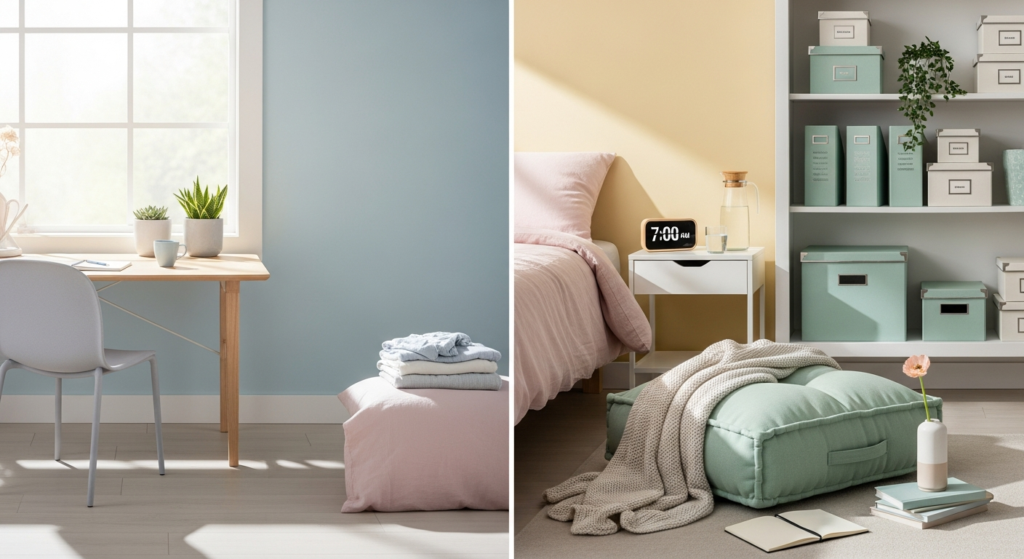
If you want to exercise every morning, lay your workout clothes out on the floor the night before so you literally step on them when you get out of bed. If you want to drink more water, place a filled carafe on your desk at the start of the day.
You can also use “Habit Stacking” in your physical space. Link a new habit to a physical location. For example, “When I sit in the blue armchair, I only read non-fiction.” Over time, the armchair itself becomes a trigger for the behavior. Your home becomes a map of your intentions, where every corner reminds you of the person you are becoming. By reducing the number of decisions you have to make each day, you preserve your “decision capital” for the work that truly matters.
6. The “Closing Shift” Ritual: Resetting for Tomorrow
A productive home environment is not static; it is a cycle. One of the biggest obstacles to productivity is waking up to yesterday’s mess. Clutter is a “visual reminder of tasks undone,” which creates low-level chronic stress.
To combat this, implement a “Closing Shift” ritual. Borrowed from the hospitality industry, this involves spending 10 to 15 minutes at the end of each day resetting your environment.
* **Clear the Desk:** Put away pens, close notebooks, and wipe down your surface.
* **Reset the Kitchen:** Load the dishwasher and clear the counters.
* **Prepare the Triggers:** Set out your coffee mug or your gym bag for the morning.
This ritual acts as a psychological “shutdown” command. It tells your brain that the productive day is over and it is safe to rest. More importantly, it ensures that when you wake up, your environment is working *with* you rather than *against* you. You start the day with a clean slate, both physically and mentally.
***
FAQ: Frequently Asked Questions
#
1. How can I create a productive workspace in a very small apartment?
In small spaces, flexibility is key. Use “visual dividers” like rugs or bookshelves to separate your work area from your living area. If you use your dining table as a desk, use a specific “work tablecloth” or a desk mat that you remove when you are finished. This physical change signals a shift in mindset.
#
2. Does the color of my walls really affect my productivity?
Yes. Color psychology plays a significant role in mood. Soft blues and greens are generally best for focus and calm, making them ideal for home offices. Yellows can stimulate creativity but may cause anxiety in large doses. Avoid stark white if possible, as it can feel clinical and strain the eyes under bright lights.
#
3. How do I manage interruptions if I live with others?
Communication and physical signaling are essential. Use a “Focus Signal,” such as a specific “Do Not Disturb” sign on your door or even wearing large over-ear headphones. Establish clear “Deep Work” hours with your household where interruptions are only allowed for emergencies.
#
4. How much should I invest in ergonomic furniture?
Your health is your greatest asset. If you spend more than 4 hours a day at a desk, a high-quality ergonomic chair and a height-adjustable desk are worth the investment. They prevent the chronic back and neck pain that often derails long-term productivity and wellness routines.
#
5. What is the most important first step to improving a home environment?
Decluttering. Before buying new furniture or plants, remove everything that doesn’t serve a purpose or bring you joy. A cluttered space leads to a cluttered mind. Once the “noise” is removed, you can clearly see what your environment actually needs to support your goals.
***
Conclusion: Your Environment is Your Destiny
As we navigate the complexities of 2026, the quality of our lives is increasingly determined by the quality of our personal environments. We are no longer passive inhabitants of our homes; we are the architects of our own behavior. Creating a productive home environment is not an elitist endeavor or a pursuit of aesthetic perfection—it is a practical strategy for reclaiming your time, energy, and mental health.
By implementing spatial zoning, optimizing sensory inputs, managing digital distractions, and embracing biophilic design, you transform your home into a silent partner in your success. Remember that productivity is not about doing *more*; it is about making it *easier* to do what matters. Start small—perhaps with a “Closing Shift” tonight or a single plant on your desk tomorrow. Over time, these environmental shifts will compound, turning your home into a sanctuary where wellness and productivity coexist in perfect harmony.