
Physical Wellness vs. Mental Wellness: Finding the Balance for a Healthier You
In the rapidly evolving landscape of health and longevity, the conversation has shifted. We are no longer simply asking how to lose weight or how to reduce stress in isolation. As we move toward 2026, the global perspective on health has matured into a holistic understanding that physical wellness and mental wellness are not two separate entities competing for our time. Instead, they are two sides of the same coin, deeply intertwined and mutually dependent.
For anyone building better daily habits, the “physical wellness vs. mental wellness” debate is often the first hurdle. Should you spend your extra hour at the gym or in meditation? Is a strict diet more important than emotional resilience? The truth is that prioritizing one at the total expense of the other creates an unstable foundation. True vitality emerges when we stop viewing them as rivals and start seeing them as a synergistic partnership. This guide explores the nuances of both pillars and provides a roadmap for integrating them into a seamless, high-performance wellness routine.
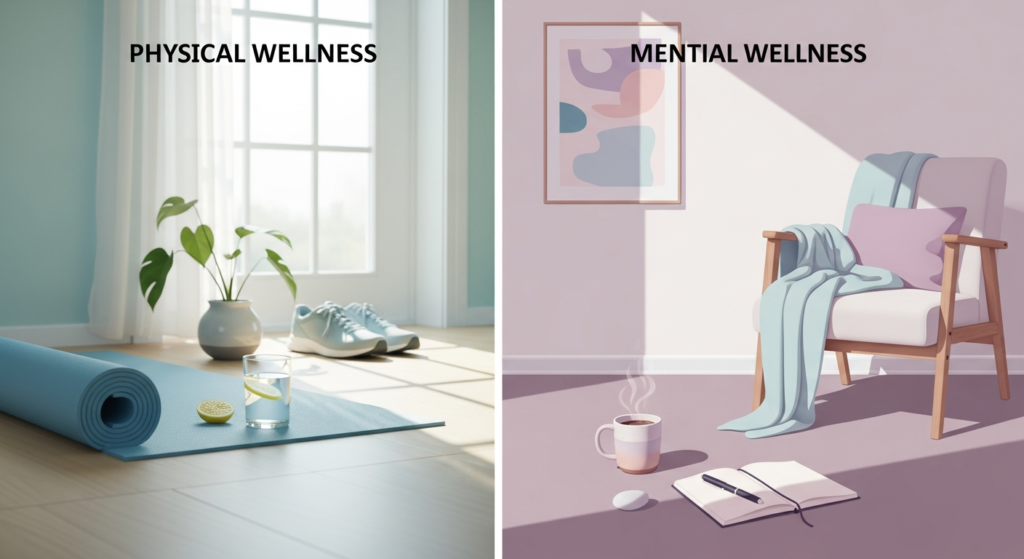
Defining the Pillars: What is Physical Wellness vs. Mental Wellness?
To build a balanced routine, we must first define the components. While they overlap, they require different inputs and yield different outputs.
**Physical Wellness** is the ability to maintain a healthy quality of life that allows us to get through our daily activities without undue fatigue or physical stress. It is not merely the absence of disease; it is the presence of vitality. It encompasses:
* **Nutrition:** Fueling the body with micronutrients and macronutrients that support cellular function.
* **Movement:** Functional strength, cardiovascular health, and flexibility.
* **Sleep:** The biological imperative for repair and hormone regulation.
* **Physiological Maintenance:** Regular check-ups, hydration, and avoiding harmful substances.
**Mental Wellness**, on the other hand, is a state of well-being in which the individual realizes their own abilities, can cope with the normal stresses of life, can work productively, and is able to make a contribution to their community. It includes:
* **Emotional Regulation:** The ability to navigate feelings without being overwhelmed.
* **Cognitive Function:** Clarity, focus, and memory.
* **Psychological Resilience:** The “bounce-back” factor after setbacks.
* **Social Connection:** The quality of our relationships and our sense of belonging.
In the context of 2026 wellness standards, we recognize that physical health provides the “hardware” (the brain and body), while mental health represents the “software” (the thoughts and emotions). You cannot run high-level software on broken hardware, and even the best hardware is useless without an optimized operating system.
The Bi-Directional Connection: How Your Body and Mind Communicate
The most significant breakthrough in recent health science is the understanding of the “bi-directional” link. Your body is constantly sending signals to your brain, and your brain is constantly modulating your physical state.
#
The Gut-Brain Axis
Often called the “second brain,” the enteric nervous system in your gut communicates directly with your brain via the vagus nerve. Roughly 95% of your body’s serotonin—the neurotransmitter responsible for mood regulation—is produced in the gut. If your physical wellness is neglected through poor diet and processed foods, your mental wellness will inevitably suffer from increased anxiety or depression, regardless of how much you meditate.
#
Cortisol and the Stress Response
When you experience mental stress, your brain triggers the release of cortisol and adrenaline. While useful in short bursts, chronic mental stress leads to physical degradation. It increases systemic inflammation, raises blood pressure, and causes muscle tension. Conversely, physical exercise is one of the most effective ways to “burn off” these stress hormones, proving that physical action is often the best cure for a mental ailment.
#
The Endorphin Effect
We are all familiar with the “runner’s high.” Physical exertion triggers the release of endorphins and dopamine, which act as natural painkillers and mood elevators. This is the mind-body connection in its most visible form: a physical habit producing a direct mental benefit.
Building a 2026-Ready Wellness Routine: Small Habits, Big Impact
As we look toward 2026, the most successful wellness routines are built on “micro-habits” and “habit stacking.” The goal is to lower the barrier to entry so that consistency becomes inevitable.
#
1. The “Morning Movement” Stack
Instead of choosing between a workout and mindfulness, combine them. A 10-minute walk in natural sunlight serves three purposes: it sets your circadian rhythm (physical), provides a “moving meditation” (mental), and boosts Vitamin D levels.
#
2. High-Protein, High-Focus Nutrition
Transition away from restrictive dieting toward “cognitive fueling.” Focus on Omega-3 fatty acids for brain health and lean proteins for muscle repair. When you eat to support your brain, your body naturally follows suit.
#
3. The 3-2-1 Sleep Rule
Physical and mental wellness both peak during deep sleep.
* **3 hours before bed:** Stop eating (physical digestion).
* **2 hours before bed:** Stop working (mental wind-down).
* **1 hour before bed:** No screens (melatonin protection).
#
4. Active Recovery
In 2026, we no longer view “rest” as doing nothing. Active recovery—like yoga or light stretching—bridges the gap. It aids physical muscle repair while simultaneously lowering the heart rate and calming the nervous system.
Overcoming the “Either-Or” Fallacy
One of the biggest mistakes in habit building is the “Either-Or” Fallacy: the belief that you must prioritize one at the expense of the other. We often hear, “I don’t have time to go to the gym because I’m too stressed at work,” or “I’m too tired to work on my mental health because I spent two hours lifting weights.”
This mindset creates a cycle of burnout. If you are mentally exhausted, a high-intensity interval training (HIIT) session might actually be counterproductive, as it further spikes your cortisol levels. In this scenario, the “physical” choice should be a restorative walk or a swim, which supports your “mental” need for calm.
Conversely, if you feel physically sluggish, “resting” on the couch for five hours of Netflix might feel like a mental break, but it often leads to a “brain fog” that worsens your mental state. The solution is **Integrated Wellness**: choosing the activity that serves the *current deficit*.
* **If mentally wired but physically tired:** Choose Yin Yoga, stretching, or a warm bath.
* **If mentally sluggish but physically rested:** Choose a high-energy workout or a cold plunge.
* **If both are low:** Prioritize sleep and hydration above all else.
Technology’s Role in Balancing Mind and Body
By 2026, technology has become an indispensable ally in balancing these two pillars. We are no longer guessing how we feel; we are measuring it.
**Biometric Feedback:** Wearables now track Heart Rate Variability (HRV). HRV is perhaps the single best metric for the “physical vs. mental” balance. A low HRV indicates that your nervous system is under stress (either from overtraining or mental anxiety). This data allows you to adjust your daily habits in real-time.
**AI-Personalized Wellness:** AI platforms can now analyze your sleep data, your calendar stress, and your physical activity to suggest the perfect “habit of the day.” If your calendar shows a high-stress meeting day and your wearable shows poor sleep, your AI might suggest a 5-minute breathing exercise rather than a 5-mile run.
**Digital Minimalism:** Part of modern wellness is knowing when to turn the technology off. Mental wellness in 2026 is increasingly defined by our ability to disconnect from the “outrage economy” of social media. Setting physical boundaries for your devices—such as a “phone hotel” in the kitchen at night—is a physical habit that yields massive mental dividends.
Measuring Success: Beyond the Scale and the Smile
How do you know if your routine is working? Traditionally, people measured physical wellness by the scale and mental wellness by a vague sense of happiness. In a sophisticated wellness routine, we look for more nuanced markers of success.
#
Physical Markers:
* **Resting Heart Rate:** Is it trending downward?
* **Functional Strength:** Can you carry groceries, play with your children, or climb stairs without getting winded?
* **Recovery Speed:** How quickly do you bounce back after a tough workout or a long day?
* **Skin and Digestion:** Are these “outer markers” showing internal health?
#
Mental Markers:
* **The “Gap” Between Stimulus and Response:** When someone cuts you off in traffic, how long does it take for you to calm down? That gap is the measure of your mental wellness.
* **Focus Duration:** Can you engage in “deep work” for 60-90 minutes without reaching for your phone?
* **Sleep Quality:** Do you wake up feeling refreshed, or do you rely on caffeine to jumpstart your brain?
* **Emotional Flexibility:** Can you experience a negative emotion without it ruining your entire day?
By tracking these markers, you move away from the “all or nothing” mentality and toward a sustainable, long-term lifestyle.
FAQ: Navigating Physical and Mental Wellness
**Q1: Can I have good mental wellness if my physical health is poor?**
While it is possible to be resilient and positive despite chronic physical illness, it is significantly harder. Physical pain and poor nutrition create a biological environment of stress. Improving physical health—even through small steps like better hydration—almost always provides an immediate lift to mental clarity and mood.
**Q2: Which should I prioritize if I only have 15 minutes a day?**
The best 15-minute habit is one that hits both. A brisk walk outside is the “golden habit.” It provides cardiovascular benefits (physical), sunlight for vitamin D and circadian rhythm (physical/mental), and a break from screens (mental).
**Q3: Does exercise always help with anxiety?**
Usually, but not always. If your anxiety is caused by “over-arousal” (feeling jittery and overwhelmed), intense cardio might make you feel more “wired.” In those cases, “grounding” physical activities like weightlifting, Pilates, or slow yoga are often better for mental stabilization.
**Q4: How does 2026 wellness differ from previous years?**
The 2026 approach is characterized by “Personalized Integration.” We have moved past “one size fits all” diets and workouts. We now use data (wearables) and intuition (mindfulness) to adjust our habits daily rather than sticking to a rigid, punishing schedule.
**Q5: Is “brain fog” a physical or mental issue?**
It’s both. Brain fog is often a physical symptom of inflammation, poor gut health, or lack of sleep, but it manifests as a mental inability to focus. Treating it requires a physical solution (rest/nutrition) and a mental solution (reducing cognitive load).
Conclusion: The Path Forward
The journey toward a healthier you isn’t a race between your body and your mind. It is a slow, intentional process of building a lifestyle where both can thrive. In the “physical wellness vs. mental wellness” debate, the winner is always the person who chooses balance.
As you refine your daily habits for 2026 and beyond, remember that your body is the vessel through which you experience the world, and your mind is the lens through which you interpret it. Keep the vessel strong, and keep the lens clear. By integrating movement, nutrition, and sleep with mindfulness, resilience, and social connection, you aren’t just “staying healthy”—you are optimizing your entire human experience. Start small, stay consistent, and listen to the signals your body and mind are sending. The harmony between the two is where true wellness lives.